The cosmetics that women use almost every day. Various types of cosmetics are sold by various manufacturers. Recently, sales of men’s cosmetics have also been increasing, and the human pursuit of beauty is endless.
There are many kinds of cosmetics, such as skin care products (basic cosmetics), medical cosmetics (anti-wrinkle, anti-blemish, anti-sagging cosmetics), hair care and scalp care products. Here, we will focus on makeup products (foundation, lipstick, blush, mascara, etc.).
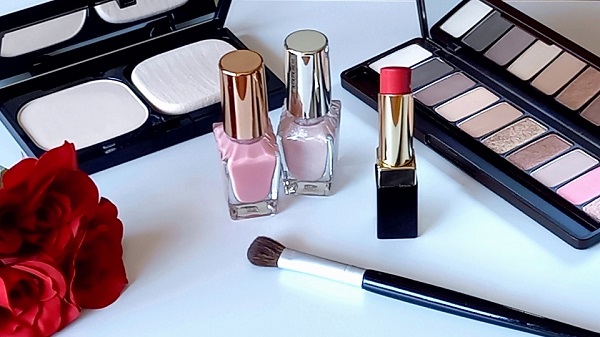
When a cosmetics manufacturer develops and releases a new product, they offer it with a wide variety of color options. They select colors that are ahead of trends and reflect consumer needs to offer a wide range of colors in their lineup. Among these, there is also a strategy of intentionally creating so-called “discard colors” to increase color variation. In such strategies, color inspection plays a very important role.
Artificial solar lighting is indispensable for accurately reproducing the color of cosmetics. In color evaluation, measuring instruments are used for color quality control, but since the color of the product on the shelf and the color after being applied to human skin give different impressions, sensory tests (*1) by humans are also conducted.
(*1) Inspection to determine product quality using human senses (such as sight, hearing, taste, smell, touch, etc.)
In this sensory test, visual evaluation of how the color actually appears when applied to the skin is extremely important. For this reason, XELIOS artificial solar lighting has become a lighting device that is widely used by cosmetic manufacturers.
Matching the color of the cosmetic on the package with that of the actual cosmetic product is also an important point for consumers. For cosmetics sold in stores, customers can see the color of the product directly, but for cosmetics whose color cannot be seen directly, the color on the package becomes an important factor in the purchase decision.
Therefore, cosmetic manufacturers and printing manufacturers work together to adjust the colors so that the colors of the package and the product match. Because not only color management by measuring instruments but also sensory evaluation by visual observation is conducted at this stage, artificial solar lighting plays an active role.
There are various factors that influence the sale of cosmetics beyond just color, but color is an important element.
Each of the following are necessary in color management in the development and manufacture of cosmetics:
① Development stage: Examination of the color of the cosmetic itself and the color when applied to the skin
② Commercialization/production stage: Inspection of color on package
At each stage, quantification by measuring instruments and sensory evaluation by visual inspection are conducted.
Lighting is extremely important in sensory evaluation, and artificial solar lighting is used by many cosmetics manufacturers.
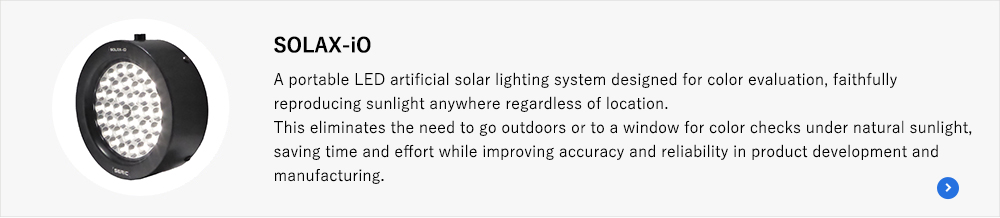
XELIOS artificial solar lighting, used in the cosmetics industry, has extremely high color reproducibility and is widely recognized in the industry. In particular, the XELIOS-100W Series and XELIOS-iO Series have been adopted by many cosmetics manufacturers as the optimal LED lighting for color evaluation. This lighting reproduces subtle differences in color with high precision, making them indispensable for color evaluation in cosmetics development.

We also provide demo units, allowing you to illuminate actual products and check the color differences. If you are interested in color evaluation of cosmetics, please feel free to contact us.