I’ve heard that aircraft evaluation tests include an item called the “Sunlight Readable” evaluation, which assesses the visibility of cockpit displays.
In Top Gun, Tom Cruise always wears a helmet or sunglasses when piloting a fighter jet. I can’t really recall any scenes, and this is based wholly on what I’ve seen from movies, where an aircraft pilot flies without any sort of eye protection.
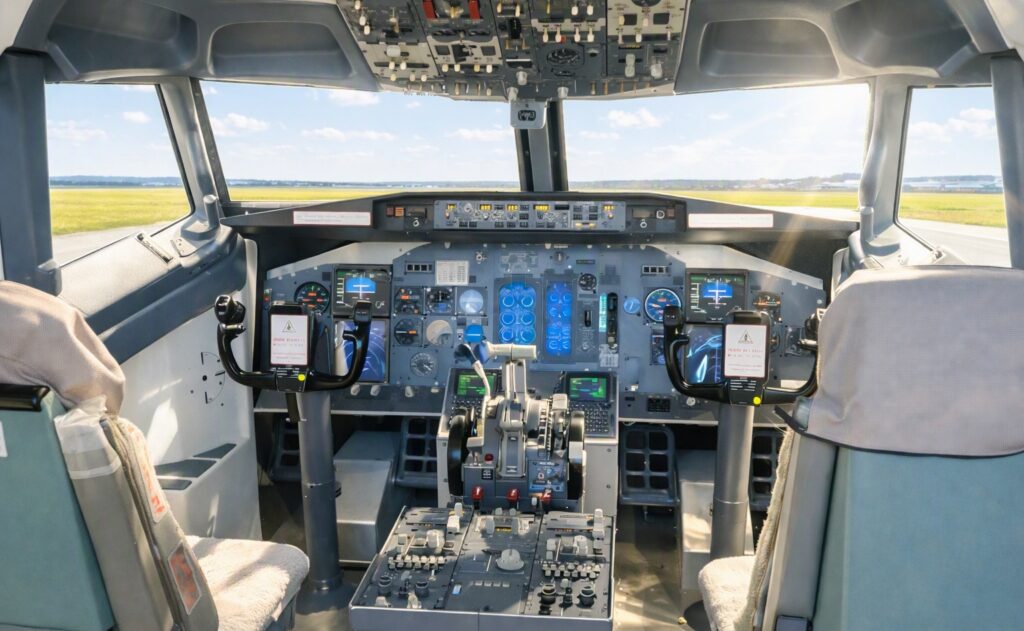
At a cruising altitude of 10,000 m, the atmosphere is so thin that there is almost none of the dust or debris found at ground level. This means that the cockpit pilots are exposed to higher levels of illuminance than they would be at ground level. In such environments, protecting the eyes with something like sunglasses or a helmet visor/shield is essential.
This means that the cockpit display needs to have higher brightness and visibility.
Separate standards have been established for civilian and military aircraft because the cockpit environments differ (e.g., in the proportion of glass and the amount of white-colored material).
・Civil aircraft standard: SAE ARP5289/ARP1874
Assuming operation above the clouds, a device must be clearly readable without risk of misreading in an ambient environment of 86,100 Lx (8,000 foot-candles) to 107,640 Lx (10,000 foot-candles).
・Military aircraft standard: MIL-STD-3009
Assuming a high altitude completely free of atmospheric effects, evaluation is conducted with a combination of diffuse light of 107,640 Lx (10,000 foot-candles) and a high-intensity spot light source simulating the direct reflection of the sun.
In either case, an illuminance of 107,640 Lx is required, which is higher than the 100,000 Lx that is required on the ground.
Our artificial solar lighting was adopted for the visibility evaluation of cockpit instruments. Below are a few examples that we can share.
● Reproducing the contrast between the sky and instruments
The goal of this test was to verify whether the instruments could be seen without misidentification when the line of sight was shifted to the instruments while looking at the sky ahead from the cockpit.
A translucent acrylic panel was combined with our XG-500AFSS artificial solar lighting
to create a surface light source that made the acrylic panel look like the sky. A sensory evaluation was conducted by having participants repeatedly look between the acrylic panel (representing the sky) and the instruments to assess whether the instruments remained clearly visible after their eyes had adapted to the sky’s brightness.
● Reproducing direct sunlight exposure on instruments
The XG-500AFSS artificial solar lighting
irradiates instruments with 100,000 Lx of light, and backlight brightness, differences in visibility by color, and the characteristics of antireflection coatings/films are evaluated. The customer’s specification did not include 107,640 Lx when they made their request.
● High-illuminance irradiation on LCD display surfaces
Visibility (Sun Light Readable) was evaluated by irradiating the display surface (LCD panel) of the aircraft display with a 107,640 Lx light.
Unfortunately, given that the information that can be disclosed for aircraft-related evaluations in particular is limited, we cannot share the multitude of other application examples. Additionally, as there may be a lot of information we are not yet aware of, there may be uses that we do not yet know about.
The model chosen by users (manufacturers) conducting cockpit visibility evaluations is mainly the Super Spotlight Lighting type 500W series XG-500AFSS.
Because this system can irradiate an area with a diameter of φ10 cm at an intensity equivalent to that of natural sunlight, it is highly regarded by customers who require illuminance equivalent to natural sunlight.

For customers who wish to irradiate not only visible light but also ultraviolet light, we recommend the 500W Super Spotlight Lighting type XG-500BFSS.
And for those who want to verify the effects of both ultraviolet and infrared light, we recommend the XG-500LFSS.
As a single lamp can only illuminate a narrow area, customers sometimes use multiple lamps together to illuminate a relatively wide area.
Being an aircraft pilot is a dream job. It is great to see someone looking sharp and intelligent in their uniform, healthy in both body and mind, isn’t it? On the other hand, that profession also carries a heavy responsibility, as it involves the lives of many people.
Because the misreading or overlooking of an instrument might lead to a mistake that costs someone their life, the visibility evaluation of those instruments becomes a critical test item.
Being involved, even indirectly, in the sort of work that concerns human life is both an honor and a heavy responsibility. That is precisely why we must provide light source devices that are capable of conducting accurate tests.
It is with this belief that we manufacture our artificial solar lighting.
Please refer to the following pages for the specifications and performance of artificial solar lighting.
・Artificial concentrating-type solar lighting (super spotlight type) capable of producing 1sun (1,000 W/m2) or 100,000 Lx
・Artificial Solar Lighting – XELIOS 500W Series


