In recent years, space-related development has been thriving.
While research and development of rockets, satellites, and lunar exploration robots require enormous investment, Japan is leveraging its strengths in miniaturization and weight reduction to advance development aimed at efficient, low-cost operations.
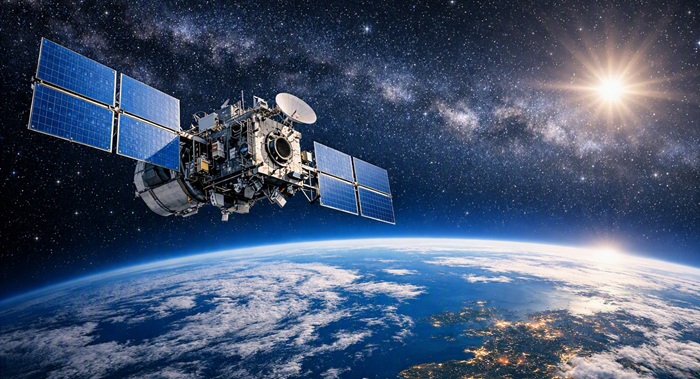
Sunlight in space has different properties from sunlight on Earth.
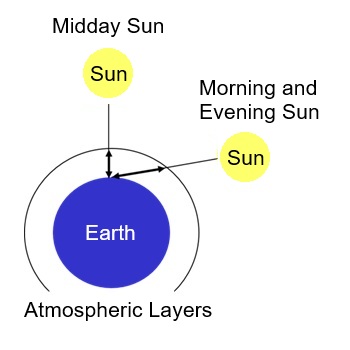
Sunlight reaching the Earth’s surface is attenuated as it passes through layers of the atmosphere. Ultraviolet radiation in particular is strongly attenuated. The thickness (path length) of the atmospheric layer through which sunlight passes before reaching the Earth’s surface differs between midday, morning, and evening; sunlight has greater energy at midday, when atmospheric attenuation is lower. These factors cause sunlight reaching the Earth’s surface to vary significantly with the time of day and the season.
The standard reference solar radiation on Earth is sunlight incident at an angle of approximately 45° to the Earth’s surface. This standard is known as AM1.5 (Air Mass 1.5) sunlight.
Factors that attenuate or scatter sunlight on Earth, such as the atmosphere, water vapor (clouds), dust, and aerosols, do not exist in outer space.
In addition, because the distance from the Sun is nearly the same in the vicinity of Earth, sunlight in outer space can be defined as a single reference standard.
This standard is specified in ISO 15387:2005(Space systems—Single-junction solar cells—Measurements and calibration procedures), and the reference sunlight defined therein is known as “AM0 (Air Mass Zero).”
Air Mass originally refers to the mass of the atmosphere and is a value calculated from the angle of incidence of direct sunlight reaching the Earth’s surface. However, because there is no atmosphere in outer space and sunlight cannot be described using this concept, this value is expressed as “0” (zero).
Solar cells used in space are evaluated by irradiating them with AM0 light.
ISO 15387:2005 specifies that irradiation testing be conducted at an irradiation intensity of 1,367 W/m².
Although ultraviolet radiation at shorter wavelengths than on Earth (in the wavelength range below 300 nm) exists in outer space, solar cells are not sensitive to this wavelength range. This means that the ISO contains no provisions for it.
We therefore offer light source systems capable of irradiating samples with “artificial sunlight exhibiting AM0 spectral characteristics at an irradiance of 1,367 W/m².”
SERIC offers light source systems capable of providing the irradiation intensity of 1,367 W/m² specified in ISO 15387 with high spatial uniformity.
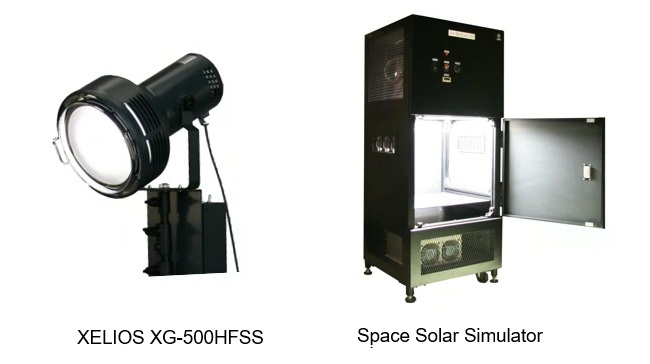
●Space Solar Illuminator “XG-500HFSS”
Product Page: https://en.seric.co.jp/products/xc500hfss/
This model can irradiate an area 10 cm in diameter at 1,367 W/m² ± 5% from an irradiation distance of 50 cm.
●Space Solar Simulator SML-2K1UV0
Product Page: https://en.seric.co.jp/products/sml-am0/
This model is suitable for customers who wish to conduct tests over a larger irradiation area than that provided by the Space Solar Illuminator XG-500HFSS.
・□ 30cm square area can be irradiated at 1,367 W/m² ± 15%.
・Although its spatial uniformity is not as good as that of the space solar illuminator, it is ideal for continuous testing, as it has a longer service life (2,000 hours) than that of a xenon lamp.
・It can also be customized to improve spatial uniformity or irradiate a larger area.
Please contact us using the “Contact” button below.
Our light source systems have been adopted by multiple companies and research institutions for evaluating the solar cells used in artificial satellites. Based on this track record, we believe that our light source systems can be adopted with confidence.
There is a certain excitement to being involved in the space industry. Many people are fascinated by space. Being able to support work filled with dreams, aspirations, and excitement is a great joy for us.
If you are facing challenges in evaluating solar cells for satellite applications, please contact SERIC. Our sales representatives have a diverse array of experience, and they will provide you with attentive support.


